You've decided to let an AI agent touch a trading account. The next fork in the road is quieter than it sounds but shapes everything after it: does the agent reach the exchange through an MCP server, or straight through the venue's raw API? It's the "mcp vs api" question, and it isn't a question of which is better — an API isn't a worse MCP, it's the lower layer the MCP is usually built on top of. This guide explains the real difference, walks the trade-offs for a trading agent specifically, and helps you pick the one that fits how hands-on you want to be. Both can run on OpenClaw Direct; the choice is about plumbing, not permission.
MCP vs API: What's the Actual Difference?
An API is the interface a service exposes for other software to call. A crypto or brokerage venue publishes a REST API for placing orders and reading balances, and often a WebSocket API for a live stream of prices and fills. It's precise and complete, and completely unopinionated about who's calling it — a human's script, a hedge fund's execution engine, and your AI agent all look identical to it. What the API does not do is explain itself in terms a language model can reason over. It hands you endpoints and status codes; turning those into an action an agent understands is your job.
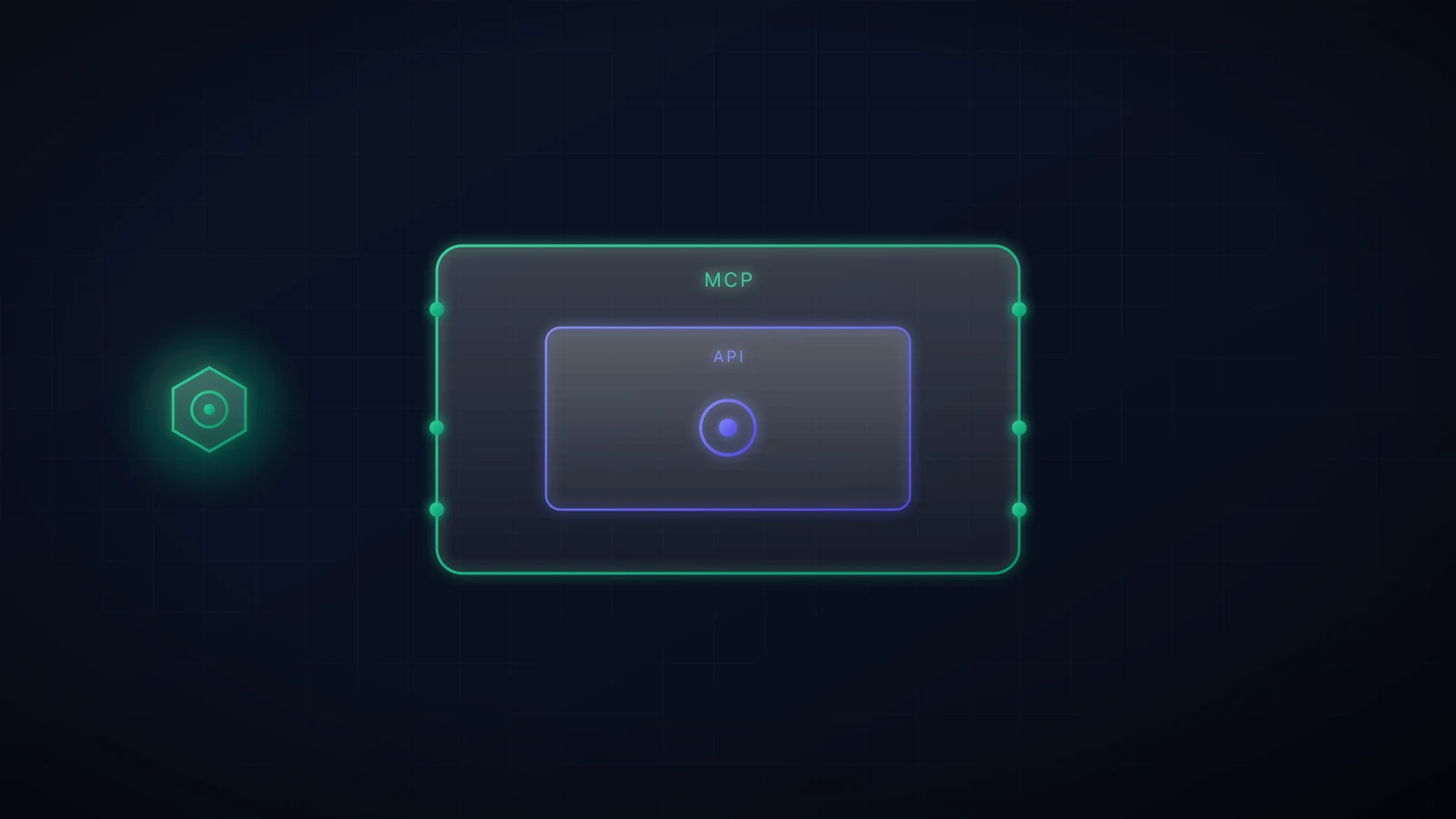
MCP is the layer that does that translation. It's an open standard, introduced by Anthropic in late 2024 and since adopted well beyond it, for exposing a system's capabilities to an AI agent as tools: named actions with descriptions and typed inputs the model can read at runtime and call in plain language. An MCP server for a trading venue turns "cancel all open orders on ETH" from a sequence of authenticated HTTP calls you wrote into a single tool the agent can discover and invoke. The MCP still talks to the venue's API underneath — it just presents that API in a shape an agent was built to consume.
So the honest framing isn't MCP versus API. It's MCP over API, or API on its own. The real decision is how much of the plumbing between your agent and the exchange you want to write and maintain yourself, and how much you want a standard protocol to handle for you.
How Each One Looks to a Trading Agent
Picture the agent about to open a small long. Through an MCP, it sees a tool list the moment it connects — get_positions, place_order, set_leverage, each with a description of what it does and what arguments it takes. The agent reads that menu, reasons about which tool fits its intent, fills in the parameters, and calls it. Nobody hard-coded the URL or the request body. The protocol negotiated all of that in a standard handshake, the same one covered in our MCP explainer.
Through a raw API, that same trade is code you own. You (or a library you pulled in) hold the endpoint paths, sign each request with the venue's key scheme, serialize the order into the exact JSON the venue expects, parse the response, and handle the 429 when you've hit the rate limit. The agent doesn't "discover" anything; it calls the functions you wrote, and if the venue changes an endpoint, you're the one who updates them. That's more work — and also more control, because every byte on the wire is something you decided.
This is the same split we draw in MCP server vs AI agent: the agent is the reasoner, the MCP server is the hands. A raw API skips the standardized "hands" layer and asks your own code to be the hands instead. Neither is cheating. They're different amounts of you in the loop.
MCP vs Raw API, Side by Side
Here's the comparison across the dimensions that actually matter when the account has money in it. Read it as a map of trade-offs, not a scoreboard — the right column changes with the trader.
| Dimension | MCP server | Raw REST / WebSocket API |
|---|---|---|
| How the agent calls it | Discovers named tools and calls them in natural language; the protocol handles the wire format. | Calls functions you wrote that build signed HTTP/WebSocket requests by hand. |
| Auth & keys | Key lives in the server's config once; the agent never sees or handles it. | You manage keys, signing, and refresh in your own code and secrets store. |
| Tool discoverability | Self-describing — the agent reads the tool list and descriptions at runtime. | None built in; the model only knows what your prompt and code tell it. |
| Maintenance | The server author absorbs venue API changes; you update a dependency. | You own every endpoint change, rate-limit tweak, and schema shift. |
| Model-agnosticism | Any MCP-capable model can use the same server unchanged. | Portable in principle, but tool wiring is often coupled to one framework. |
| Latency & control | One extra hop; fine for most strategies, not for microsecond execution. | Lowest latency and total control over batching, streams, and retries. |
| Guardrails | Natural fence points — cap, whitelist, or gate at the tool boundary. | You build every check yourself, wherever your code touches the venue. |
| When it wins | Fast to wire, portable across models, easy to keep safe — most agents. | Latency-critical, exotic order types, or a venue with no decent MCP. |
When a Direct API Still Wins
Reach past MCP and straight for the API when control is the whole point. If your strategy lives or dies on latency — market making, tight arbitrage, anything measured in milliseconds — the extra hop through an MCP server is a hop you may not want, and you'll want to hold the WebSocket connection and order batching yourself. The API is also the answer when you need an order type or venue feature no MCP has bothered to wrap yet: some exchanges expose dozens of parameters, and a tidy tool menu rarely covers all of them.
There's also the plain case of a venue with no MCP worth using. Not every exchange has one, and a thin or unmaintained server can be worse than none — you inherit its bugs without the control to fix them fast. When you'd rather own every dependency and read every byte on the wire, the raw API is the honest choice. The cost is real, though: you're now maintaining signing logic, rate-limit handling, reconnect logic, and schema parsing for as long as the agent runs. That's a standing job, not a one-time setup.
When MCP Wins
For most people wiring up a trading agent, the MCP is the faster, safer road. You skip the whole plumbing layer: no signing code, no rate-limit bookkeeping, no serialization to babysit. The server exposes the tools, your agent discovers them, and you're testing a real "read my positions" call in minutes instead of an afternoon. Because MCP is a standard, the same server works whether your agent runs Claude, a GPT model, or something open-source — swap the model and nothing about the trading connection changes.
The safety story is the part that matters most on a live account, and it's underrated. Because every venue action passes through a named tool, the tool boundary becomes a natural place to enforce rules. A leverage cap, a per-trade notional limit, a coin whitelist, a "read-only until I approve" gate — these clip onto tool calls cleanly, the way we lay out in the trading-agent safety hub. With a raw API, the same guardrails are possible, but you're scattering them across your own code wherever a request gets built, and a check you forgot in one path is a check that isn't there. Fewer places for the fence to have a gap is a real safety property when the downside is a bad fill.
The Setup Most People Actually Run: MCP Over API
Here's the resolution to the false fight. In practice, the common trading setup isn't MCP or API — it's an MCP that wraps the API. The server does the low-level work you'd otherwise write by hand: it holds the venue key, signs the requests, respects the rate limits, and parses the responses. Then it hands your agent a clean menu of tools. You get the API's full reach and the MCP's discoverability and guardrails at the same time, and you maintain a dependency instead of a codebase.
The real venues already look like this. There are MCP servers for Robinhood-style agentic crypto trading, Coinbase's Base MCP wrapping onchain wallet and trade actions, and multiple Hyperliquid MCPs sitting on top of Hyperliquid's perpetuals API. Each one is a wrapper over that venue's native API, built so an agent can reason about trading rather than about HTTP. When you pick one of these, you're not choosing MCP instead of the API — you're choosing to let the server own the API so your agent doesn't have to.
Does that mean MCP is always the move? No. If you're the millisecond-arbitrage type, or you need an order type nobody wrapped, drop to the API. But for the reader deciding how to connect an agent to Coinbase Base, Hyperliquid, or a brokerage for the first time, the MCP-over-API path is the one that gets you to a safe, model-agnostic, testable setup fastest — and it's the one nearly every worked example in this cluster uses.
Where the Choice Lands, and Where It Runs
Whichever layer you connect through, the agent and its MCP have to live somewhere that stays online while the market does. A trading loop that only runs when your laptop is awake is a loop that sleeps through the move that mattered — and a signing key sitting in a plaintext file next to your browser is the wrong place for the thing that can place orders.
That's the gap OpenClaw Direct fills. Every agent runs on its own isolated Instance, with your venue key — whether it feeds an MCP server or your own API code — encrypted at rest in the platform's credential vault instead of on your machine. The infrastructure holds 99.9% uptime with monitoring, keeps a full audit trail of every action the agent takes, and reaches you on Telegram so you can approve a trade before it fills. It's model-agnostic by design, which pairs naturally with MCP's model-agnostic tools: pick the model you trust, keep the same trading connection. The Advanced plan is $29/month, and every subscription includes free trial credits — enough to wire up an MCP, fire a few read-only calls, and watch the whole thing work before you commit real size.
Wire up your trading agent the safe way
Run your agent and its MCPs on OpenClaw Direct. Isolated Instance, encrypted vault, free trial credits included.
Run OpenClaw NowWhich Should Your Trading Agent Use?
Start with an MCP. For nearly every trader connecting an agent to a venue, it's faster to wire, portable across models, and — the part that counts when there's money on the line — easier to keep safe, because the guardrails clip onto named tools instead of being scattered through code you wrote. Drop to the raw API when you've hit a real wall: latency that a hop can't afford, an order type nobody wrapped, or a venue whose only MCP you wouldn't trust. And remember the setup most people land on isn't a choice between the two at all — it's an MCP that wraps the venue's API, giving you the reach of one and the discoverability and safety of the other.
The layer you pick matters less than the discipline around it: start read-only, add a human approval step, cap the size, and judge the agent on live results before you widen its leash. That's true whether the agent is calling a tool or an endpoint. If you want a place to run it that keeps the key off your laptop and the agent online when the market is, that's what we built OpenClaw Direct for — free trial credits come with every plan, so you can connect an MCP end to end and watch your first reads and orders fire.
Sources: Model Context Protocol — Introduction & Specification, Anthropic — Introducing the Model Context Protocol, GitHub — Model Context Protocol reference servers, GitHub — Coinbase base/base-mcp, and Hyperliquid Docs — API.