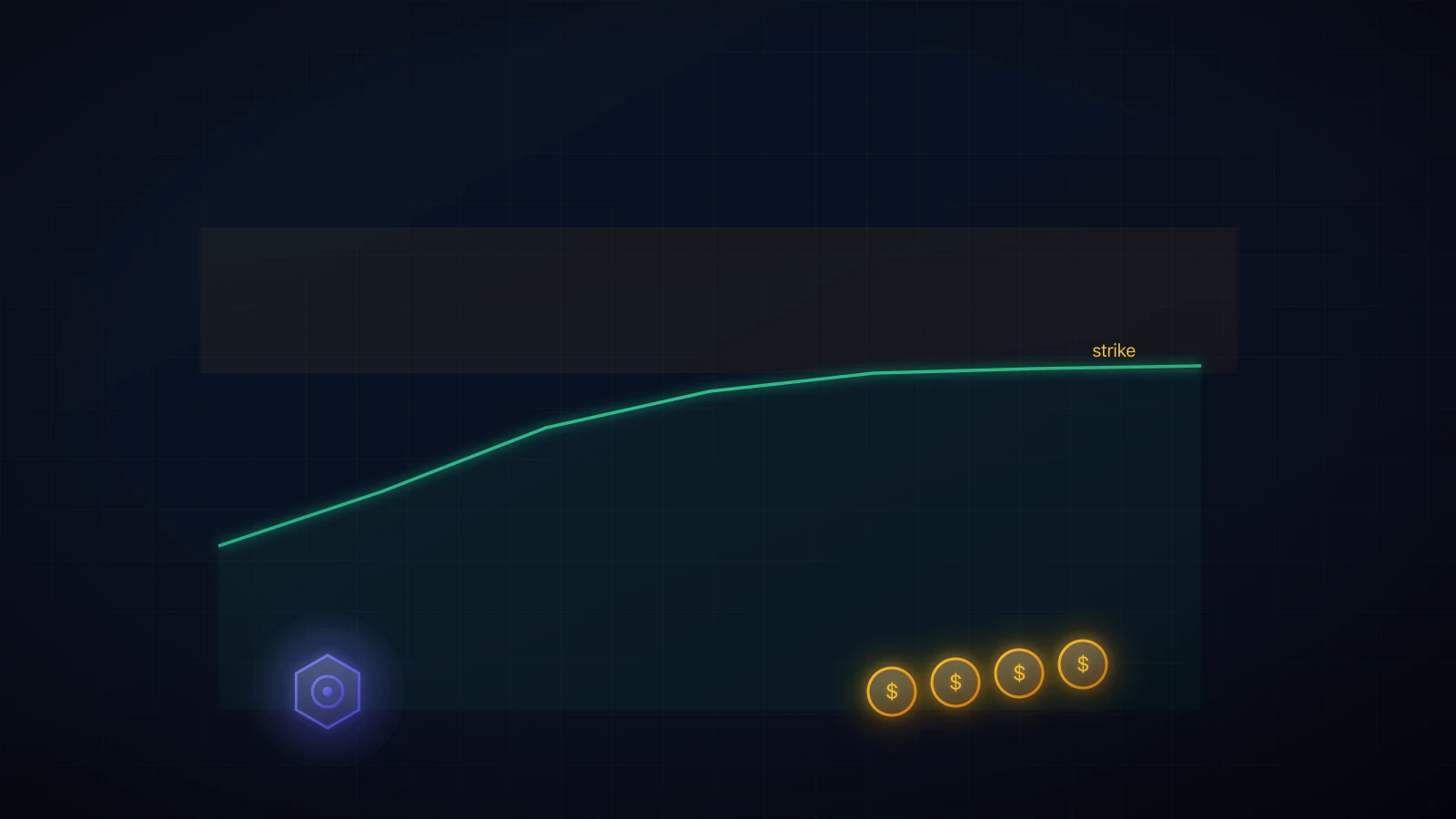
The covered call is the income strategy the theta crowd on Reddit never stops recommending: own 100 shares of something you already wanted to hold, sell one out-of-the-money call against them, and pocket the premium the buyer pays you. It caps your upside above the strike and keeps every bit of your downside, so it's income with a catch, not a free lunch. It's also a rule-shaped, calendar-driven job — pick a strike, sell the call, watch it to expiry, roll or hand over the shares — which is exactly the kind of repetitive discipline an always-on agent handles better than a human who forgets to log in on expiration Friday. This post hands you a copy-paste covered-call skill you can save to your OpenClaw Direct Instance: it picks a strike by a delta rule you set, sells the call on a schedule, rolls by your rule, handles assignment, and asks for Telegram approval before it signs anything.
What Is a Covered Call, Really?
A covered call has two legs. You own at least 100 shares of a stock (the "cover"), and you sell one call option against those shares — one contract per 100 shares. The buyer pays you a premium upfront for the right to buy your shares at a set strike price before the option expires. You keep that premium no matter what happens next. In return, you've agreed that if the stock climbs above the strike, your shares can be called away at that strike and you don't get the gains beyond it.
That trade-off is the whole strategy. You're selling your upside above the strike for cash today. If the stock stays flat or drifts up slowly, the call expires worthless, you keep both the premium and the shares, and you can do it again next month. If the stock rips past the strike, your shares get sold at the strike — you still made money, just less than if you'd held. And if the stock falls, the premium softens the blow slightly, but you eat the rest of the loss because you still own the shares. Income on the top, unchanged risk on the bottom.
This is why the r/thetagang community treats it as a bread-and-butter income play rather than a get-rich trade. The name is a nod to theta — the option "Greek" that measures how an option loses value as expiration approaches. As a call seller, that decay works for you: every day the option ages, it's worth a little less to buy back, and that erosion is your income. Boring and mechanical — which is exactly what makes it a candidate for automation.
Why the Covered-Call Strategy Suits an Always-On Agent
A covered-call program is really a rolling calendar of small, identical decisions. Every cycle you ask the same questions: which of my holdings has no call written against it, what strike matches my delta rule, how many days to expiration, and is today the day to roll the one that's expiring? None of that requires cleverness. It requires showing up on schedule and following the rule the same way every time — the one thing humans reliably fail at and software reliably does well.
Think about where a manual covered-call habit breaks down. You mean to roll the call the week it expires, but you're traveling. The stock gaps above your strike on a Tuesday and you don't notice until Friday. You sell a strike that's too tight because you eyeballed it instead of checking the delta. An agent that runs on a cron schedule during market hours checks every position on every run, applies the exact strike and roll rules you wrote, and never forgets it's expiration Friday. The strategy rewards discipline over instinct, and discipline is what an agent is for.
The natural comparison is the DCA skill: both are calendar-driven, both reward consistency, both are low-drama by design. The covered call is a step up in complexity because it involves options, assignment, and broker approval tiers — so the guardrails matter more. But the shape is the same. Encode the rule once, cap what it can do, and let a hosted agent run it while you get on with your life.
What the Covered-Call Skill Actually Does
A "skill" here is a small persistent instruction file your OpenClaw agent reads on every run — not a chat message that disappears when memory compacts. The covered-call skill encodes six things: which stocks it may write calls against (and only stock you already own), how it picks a strike, when it sells, when it rolls, what it does on assignment, and the hard caps it can never cross. Together they turn "sell covered calls for income" from a vague plan into a rule the agent executes identically every cycle, whether you're watching or not.
The single most important guardrail is the word "covered." The skill may only sell a call when the agent has confirmed you already hold at least 100 shares of that exact stock for each contract it writes. That's what keeps this a covered call and not a naked one — a naked call has theoretically unlimited loss and belongs nowhere near a first agent. The pre-flight check that verifies share ownership before every order isn't a nicety; it's the line between an income strategy and a way to blow up your account.
Everything else is bounded judgment. The strike selection is a delta rule, not a guess. The roll is a written trigger, not a vibe. Assignment has a defined response so the agent never improvises when your shares get called away. And above all of it sit a position cap and a notional cap, plus a Telegram approval on every order, so nothing signs without either fitting inside your limits or getting your explicit yes first.
The Copy-Paste Skill Spec
Here's the skill in plain English. Save it to your Instance as a skill file (see how to structure your AGENTS.md and skills), swap in your own tickers and numbers, and point it at whichever broker MCP you've wired up. The dollar figures below are illustrative placeholders — set your own. It's written as instructions to the agent, not code, because that's what an OpenClaw skill is:
SKILL: Covered-Call Income

GOAL
  Generate premium income by selling out-of-the-money calls ONLY
  against shares I already own. Never sell a call I can't cover.
  Never exceed the caps. Ask before signing.

UNDERLYING WHITELIST (only these, and only if I own the shares)
  AAPL, MSFT, KO
  Do nothing for any ticker not on this list, even if I own it.

COVER CHECK (the rule that makes this safe — run FIRST, every time)
  For each ticker, read my current share count from the broker.
  Contracts I may sell = floor(shares owned / 100) MINUS calls
  already open against that ticker. If that number is 0 or less,
  write nothing. NEVER sell a call that isn't fully covered by
  shares I hold right now. No naked calls, ever.

STRIKE SELECTION (delta rule, not a guess)
  Target an out-of-the-money call at ~0.30 delta (range 0.25-0.35).
  Expiry: 30-45 days to expiration (DTE); pick the nearest listed
  expiry inside that window.
  The strike must be ABOVE my cost basis for those shares, so if
  assigned I don't lock in a loss on the stock. If no strike meets
  both the delta band and the above-cost-basis rule, write nothing
  and report why.

WRITE SCHEDULE
  Run on a cron during US market hours only (e.g. weekdays 15:30 UTC).
  Only open a new call for a ticker that has covered shares and no
  open call against them. One call cycle at a time per ticker.

ROLL RULE
  Manage an open call when EITHER is true:
    - 21 DTE or fewer remain, OR
    - the option's value has decayed to <= 30% of the premium I sold
      it for (most of the income is captured — take it).
  To roll: buy back the current call and sell a new one at the delta
  and DTE targets above, at a strike >= the current one (roll up and
  out). Only roll for a net credit or break-even; if rolling would
  cost a net debit, do NOT roll automatically — flag it for approval.

ASSIGNMENT HANDLING
  If a call is assigned (shares called away at the strike):
    - Do nothing frantic. This is a normal outcome; I kept the
      premium and sold the shares at a strike above my cost basis.
    - Log the assignment: ticker, strike, premium kept, realized P/L.
    - Do NOT automatically re-buy the shares to write another call.
      Send a Telegram summary and wait for my instruction.
  Watch for EARLY assignment risk near ex-dividend dates on
  in-the-money calls; flag any in-the-money call before ex-div.

APPROVAL (human in the loop — every order)
  Before selling, buying back, or rolling ANY option, send a Telegram
  message with the full ticket: ticker, action, strike, expiry, delta,
  contracts, and the premium/credit. Wait for an explicit "approve"
  or "reject". Sign nothing without approval.

CAPS (hard limits — these always win)
  Position cap:  never more than 5 open call contracts total.
  Per-ticker cap: never more than 2 open calls per ticker.
  Notional cap:  total shares under written calls may not exceed
                 $10,000 of underlying value (illustrative — set yours).
  Before every action, read open positions and enforce all caps. If
  an action would breach any cap, skip it and report why.

SAFETY
  Never sell a naked or uncovered call. Never sell puts, spreads, or
  any strategy not defined here. Never use margin. Only trade during
  US market hours. On any error, missing data, ambiguous price, or
  broker-approval failure: do nothing, log it, and send a Telegram
  notice. Do not retry blindly.

REPORT
  After every run, post a one-line Telegram summary: calls opened or
  rolled, strikes and expiries, premium collected this cycle, open
  contract count vs the position cap, and any assignments.
Read it once and the priorities are obvious: the cover check runs before anything else, the strike rule keeps you above cost basis, the roll captures most of the decay before it evaporates, and two independent caps plus per-order approval make the worst case a known, small number. Tighten it for your first month — a shorter whitelist, a lower notional cap, approval on every order regardless — then loosen it only once you've watched it behave.
Picking the Strike: Delta, Expiry, and the Roll
Delta is the shortcut the whole strategy leans on. For a call, delta runs from 0 to 1 and doubles as a rough, market-implied probability that the option finishes in the money. A 0.30-delta call sits comfortably out of the money — loosely, the market prices it as somewhat unlikely to be assigned — which is why it's a common covered-call target. Sell closer to the money (higher delta) and you collect more premium but cap your upside tighter and get assigned more often. Sell further out (lower delta) and you keep more upside but collect less. The 0.25–0.35 band in the skill is a middle path, not a magic number; adjust it to how willing you are to have the shares called away.
Expiry is the other lever. Selling 30–45 days out is the theta-crowd convention because time decay accelerates in roughly the final month of an option's life, so you're selling the part of the curve where premium erodes fastest in your favor. The roll rule then decides when to close a cycle early: rolling at 21 DTE, or once most of the premium has already decayed, banks the gain before the last stretch where the option can whip back to life on a rally. Rolling "up and out" — to a higher strike and a later date — is how you keep collecting income on shares you'd rather not lose yet, but only ever for a net credit, which is why the skill flags any debit roll for your approval instead of doing it silently.
When the Call Gets Assigned
Assignment is not a failure — it's one of the two ways every covered call ends, and the skill treats it as routine. If the stock closes above your strike at expiration, the buyer exercises, your 100 shares are sold at the strike, and you keep the premium plus every dollar of gain up to that strike. Because the skill only ever writes strikes above your cost basis, an assignment is a profitable exit on the stock, not a loss. The agent's job is to log it cleanly, tell you on Telegram, and then stop — not to panic-buy the shares back and immediately write another call without your say-so.
There's one wrinkle worth teaching your agent: early assignment. American-style equity options can be exercised before expiration, and the classic trigger is an in-the-money call the day before the stock goes ex-dividend, when the call buyer may exercise early to capture the dividend. It's uncommon but real, which is why the skill flags any in-the-money call ahead of an ex-dividend date rather than assuming assignment only happens at expiry. Knowing the one scenario where early assignment actually bites is enough to keep the agent from being surprised by it.
The Eligibility Catch: Options Aren't Open to Everyone
Here's the part the strategy guides gloss over, and it's a genuine gate: you can't just decide to sell covered calls. Options trading requires your broker to approve you for an options level, and approval depends on the account information you provide about your experience, income, and objectives. Covered calls typically sit at the lowest options tier because the risk is defined, but you still have to be approved, and not everyone is. Beyond that, options aren't available in every country or on every platform, and the tax treatment of premium and assignment varies by jurisdiction. This is not a strategy you can assume you're eligible for — check with your actual broker first.
There are two more constraints an agent has to respect that don't apply to 24/7 crypto. Options trade during US market hours, not around the clock, so the skill runs on a market-hours schedule rather than continuously — a real difference from the always-on crypto agents in our Robinhood setup guide and elsewhere. And you need enough shares to matter: one contract covers 100 shares, so a covered-call program on even a modestly priced stock ties up real capital. None of this makes the strategy bad. It makes it something to confirm you can actually do before you wire up an agent to do it.
Covered Calls Cap Your Upside — On Purpose
Automating a covered call removes the babysitting; it doesn't remove the risk, and the risks are specific. First, your upside is capped by design — if the stock triples, you sold it at the strike and watched the rest go to the buyer. That's the deal you signed for the premium, and in a roaring bull run it stings. Second, you keep the full downside of owning the shares. The premium you collect is a thin cushion, not a hedge; if the stock drops 30%, a couple of percent of collected premium barely registers. A covered call does not protect you from a falling stock — it only earns a little income while you hold one.
The agent-specific risks stack on top. It's still software placing real options orders through an API, and options move fast. The sane defaults are the same ones we apply to every trading agent: start read-only, let the skill run for a couple of weeks reading your positions, picking strikes, and posting the tickets it would place to Telegram without signing anything. Sensible tickets are your evidence the wiring works. Keep the whitelist short and the caps real — the position and notional caps are your hard floor on how much the agent can commit, so size them like a number you'd shrug at. And never, ever let the skill sell an uncovered call. The safety rails for OpenClaw trading agents hub walks through the full set, and the AI agent safety tips post covers the read-only-first habit in depth.
Where to Go From Here
The covered-call strategy is a natural second job for an agent once you've watched a DCA skill behave: same calendar discipline, one more layer of rules, and a much higher bar for guardrails because options and assignment are involved. Save the spec, swap in tickers you already own and caps you're comfortable with, confirm your broker has actually approved you for options, and run it read-only until the tickets look boring and correct. Then let it write — one small, fully covered call at a time, tight whitelist, hard caps, Telegram approval on every order. From there you can widen the whitelist or add a second Instance, but you don't have to. A steady, capped, always-on covered-call agent is already doing the mechanical part most option sellers wish they'd done consistently.
All of it depends on an agent that's genuinely online when the market is, with its broker credentials somewhere safer than your laptop. That's why we built OpenClaw Direct: a dedicated Instance per user, an encrypted key vault, cron scheduling, Telegram approvals, a full audit trail, and 99.9% uptime. The Advanced plan is $29/month, and free trial credits come with every subscription — enough to save the covered-call skill, watch a few read-only runs, and see your first ticket land in Telegram before a single contract sells.
Ready to run a covered-call agent?
Save the skill to an OpenClaw Direct Instance. Free trial credits included with every subscription.
Run OpenClaw NowSources: OpenClaw Direct — The DCA Skill: Buy the Dip on a Schedule, OpenClaw Direct — Scheduling AI Agent Cron Jobs 24/7, OpenClaw Direct — Safety Rails for OpenClaw Trading Agents, OpenClaw Direct — AI Agent Safety Tips, and OpenClaw Direct — How to Structure Your AGENTS.md for OpenClaw.