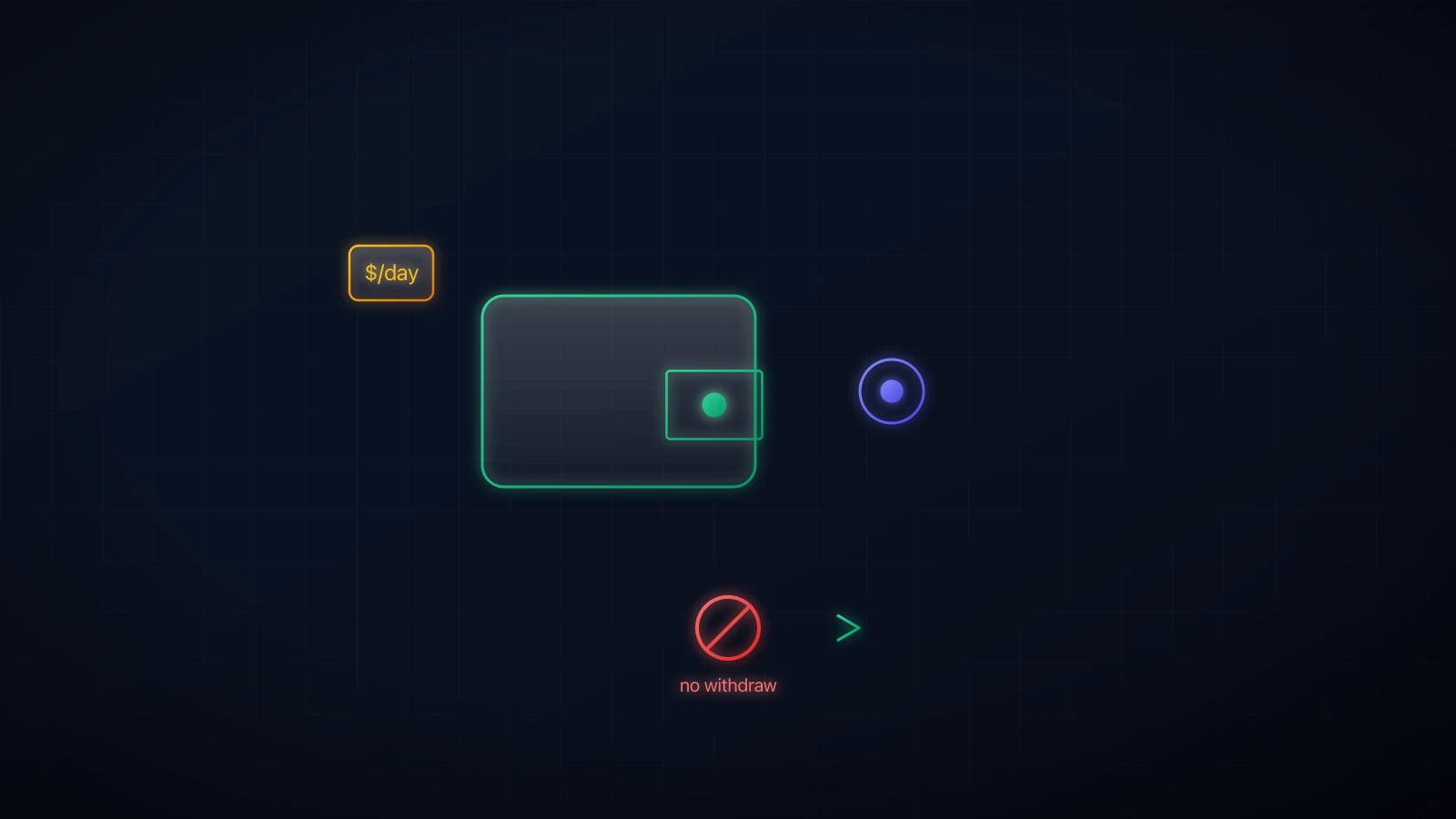
You would never hand a new hire the master key to your bank vault on their first day. Yet that's exactly what a plain crypto wallet asks of a trading agent: one private key that can trade, drain, and vanish, all with the same signature. Account abstraction — the ERC-4337 standard on Ethereum — fixes that at the wallet layer. It lets you issue an agent a session key: a scoped, time-limited, revocable permission to sign only a bounded set of actions, and nothing else. This is the onchain counterpart of the 7 safety rails — caps, whitelists, expiry, and no-withdraw — but enforced by the blockchain itself rather than by a prompt you hope the model obeys. Here's what an agent wallet actually is, why Robinhood Chain shipping first-class ERC-4337 matters for anyone running a trading agent, and how to think about spending caps before you fund anything.
What Problem Does an Agent Wallet Actually Solve?
The trouble with letting an AI agent trade onchain is the private key. A standard Ethereum account — an EOA, or "externally owned account" — is just a keypair. Whoever holds the key can do anything: swap, send, drain the whole balance to an attacker's address, all with one identical signature. There's no such thing as a key that can trade but not withdraw. The account can't tell the difference, because an EOA has no logic in it — it's a key and a balance, nothing more.
That's a terrible fit for an autonomous agent. You want the agent to place trades all day, but you never want it able to move your funds off the account, and you'd like its permission to expire on its own if you forget to revoke it. None of that is expressible with a plain key. So people fall back to the bad options: run the agent with a fully privileged hot-wallet key (a leaked key drains you) or babysit every action manually (which defeats the point of an agent). Account abstraction is the way out of that false choice.
How Does ERC-4337 Change the Wallet?
ERC-4337 is Ethereum's account-abstraction standard, live since 2023, and its core move is simple: your wallet becomes a smart contract instead of a bare keypair. Once the account is a contract, it can hold logic — rules about who may sign what, under which limits, until when. That single change unlocks a set of features a plain EOA structurally cannot offer.
- Session keys. The account can authorize a secondary signer with a scoped permission: sign only these action types, only on these tokens, only up to this amount, only until this timestamp. The main key stays cold; the session key does the day-to-day work within its box.
- Transaction batching. Approve-and-swap, or several legs of a strategy, can execute as one atomic bundle. Either the whole batch lands or none of it does — no half-finished state where an approval is granted but the trade never fired.
- Sponsored (gasless) transactions. A paymaster contract can cover gas, so the account doesn't need the native token in hand to act. The agent can trade without you pre-funding it with ETH for fees.
Of those three, the session key is the one that matters for safety. It's the mechanism that lets you describe, in enforceable terms, exactly how much rope your agent gets — and the blockchain, not the model, enforces it. A prompt can be argued with. A wallet contract cannot.
Why Is a Session Key the Onchain Version of a Permissioned Agent Wallet?
Think about what you'd actually want to tell a trading agent: "You may swap up to $500 a day, only between USDC, ETH, and BTC, and you may never withdraw. This permission dies on Friday." With an EOA, that sentence is fiction — the key can do everything or you don't give it the key. With a session key on an ERC-4337 account, that sentence is the permission. Each clause maps to a real constraint the wallet contract enforces on every signature.
A daily cap maps to a spend limit in the session policy. A token list maps to a whitelist of allowed assets. "Never withdraw" maps to excluding transfer-out actions from the signer's allowed set. "Dies on Friday" maps to an expiry timestamp, after which the key is dead weight, with no revocation call required. That's what makes an agent wallet a real permission model rather than a marketing phrase — the same limits you'd put on a permissioned employee, written in code that runs before any transaction settles.
Set that against a self-custody hot wallet. On something like Coinbase's Base with an MCP, the agent holds a real private key that controls the coins directly. It's powerful and flexible, but the blast radius is total: leak that key and the wallet empties, with no recourse and no expiry to save you. A session key inverts that. The worst a leaked session key can do is trade badly within its own caps until it expires — it was never allowed to withdraw in the first place.
How Is This Different From Hyperliquid's Agent Wallet?
If you've read our Hyperliquid guide, this will sound familiar — and it should. Hyperliquid's "agent wallet" (also called an API wallet) is a permissioned signer that can trade your account but cannot custody or withdraw your funds. That's the same safety idea: separate the right to trade from the right to move money. The difference is where the boundary is drawn, and how general it is.
Hyperliquid's agent wallet is a venue-specific feature. It's an excellent no-withdraw signer, but its powers and limits are defined by Hyperliquid's own system, on Hyperliquid's own exchange. ERC-4337 session keys are a general account-abstraction standard that any compatible app or chain can honor, and the policy is richer out of the box. It covers more than "trade but don't withdraw": per-token whitelists, rolling spend caps, and hard expiry all compose into one signer. One is a great feature of one exchange; the other is a wallet-layer primitive you can carry across the ecosystem.
Why Does Robinhood Chain Shipping ERC-4337 Matter?
Robinhood Chain launched its mainnet with first-class support for ERC-4337 account abstraction — session keys, transaction batching, and sponsored gas as first-class capabilities, not bolted-on afterthoughts (Robinhood Chain docs). That's notable because it comes from a mainstream brokerage building for mainstream users, and it signals that scoped, permissioned wallets are becoming the default surface for onchain activity rather than a power-user curiosity.
For anyone running a trading agent, that's the whole ballgame. A chain where the wallet natively understands session keys is a chain where "give my agent a bounded, expiring, no-withdraw signer" is a first-class request, not a hack you assemble yourself. It lines up directly with the way we already think about tokenized-stock trading with AI agents: the safest agent is the one whose permissions are narrow by construction. Robinhood Chain bakes that narrowness into the wallet, which is exactly where you want it.
What Should a Session-Key Policy Contain?
A good session-key policy reads like a job description with hard edges. It grants the agent enough to be useful and nothing more, and every clause is a limit the wallet enforces rather than a suggestion the model can rationalize its way past. Here's the starting set we'd reach for on any agent wallet, and it maps one-for-one onto the 7 safety rails.
- A per-transaction cap. The largest single trade the key may sign — sized so one bad fill can't wreck the account.
- A rolling daily cap. Total spend allowed per day, so a stuck loop or a bad streak can't compound past a limit you set once.
- A token whitelist. Only the assets you actually want traded — say USDC, ETH, and BTC — and nothing the agent found trending at 3am.
- No withdrawals. Transfer-out and bridge actions are simply not in the signer's allowed set. The key can trade its heart out and still can't send your funds anywhere.
- An expiry. A timestamp after which the key is inert. Even if you forget it exists, it stops working on its own.
Notice what this does to the failure modes. A prompt-injected agent can't withdraw, because withdrawal was never a permitted action. A runaway loop can't drain the account, because the daily cap holds regardless of how many times the model tries. A key you forgot to revoke expires by itself. The rails aren't advice the agent chooses to follow — they're walls it runs into. That's the entire advantage of enforcing safety at the wallet instead of in the conversation.
Where Does the Session Key Live — and Who Holds It?
A scoped key is safer than a full key, but it's still a key, and a key sitting in a plaintext file next to your browser is a key waiting to leak. The session key needs to live somewhere encrypted, on infrastructure that's actually online when the market is, with a way to pull the plug fast when the agent does something you don't like. That's the part a standard alone doesn't hand you — you have to run it somewhere.
This is what OpenClaw Direct is for. We run the onchain agent on its own dedicated machine and hold its session key inside an encrypted credential vault, scoped to your Instance and never written to a personal disk. On top of the wallet-layer caps, you get platform-layer spending caps, 24/7 monitoring so an always-on agent watches an always-on market, a browser-reachable kill switch to suspend or terminate the Instance from any device, and a full audit trail of every action the agent took. It's the same layered-defense idea from our agent safety tips: the session key limits what the agent can do onchain, and the platform limits, watches, and can stop how it does it.
Two independent stop mechanisms is the goal, and account abstraction gives you both halves. Kill the Instance and no process can sign a new order. Let the session key expire — or revoke it — and its signing rights end no matter what any process tries. And because the key was never allowed to withdraw, even a fully compromised session key can't move your balance to an attacker. That's a genuinely small blast radius for software that trades real money on your behalf.
Run an onchain agent with its key in a vault, not a text file.
OpenClaw Direct holds your session key encrypted, with spending caps, a kill switch, and a full audit trail. Advanced $29/mo, free trial credits included.
Run OpenClaw NowWhere to Go From Here
The onchain building block for a safe trading agent finally exists, and it's the same idea we keep coming back to: give the agent scoped permission, cap what it can spend, whitelist what it can touch, forbid withdrawals, and make the whole grant expire on its own. ERC-4337 turns those rules into wallet-level code, and Robinhood Chain makes them first-class on a chain built for mainstream users. Session keys are the onchain twin of the 7 safety rails — enforced by the blockchain rather than trusted to a prompt.
What's left is the part a standard can't do for you: keeping that key somewhere safe and keeping the agent online. That's why we built OpenClaw Direct — a dedicated Instance per user, an encrypted vault for your session key, spending caps, 24/7 monitoring, a dashboard kill switch reachable from any browser, and a full audit trail of every trade. Whether you start on Robinhood Chain, contrast it against a self-custody wallet on Base, or a no-withdraw signer on Hyperliquid, the principle holds: the safest agent is the one whose powers are narrow by construction. Free trial credits come with every subscription — enough to wire up an onchain agent and watch it act inside the box you drew.
Sources: Robinhood Chain Docs — Account Abstraction, Alchemy — Robinhood Chain Mainnet Is Live on Alchemy, Ethereum — ERC-4337: Account Abstraction Using Alt Mempool, ethereum.org — Account Abstraction, and Hyperliquid Docs — Nonces and API Wallets.